
Montgomery County Court Records After a Jail Arrest
After an arrest in Montgomery County, the case moves from the sheriff to the court system in steps. The arresting agency books the person at the jail. The State's Attorney then reviews the matter and files a charging document. That filing opens a case in the Circuit Court, and the docket that follows becomes the court record. The county sits in Illinois Circuit 4, District 5, with the courthouse and court complex at 120 N. Main St. in Hillsboro. Court hours run 8 a.m. to 4 p.m. on weekdays.
It helps to keep the two sides apart. The booking and custody side lives with the sheriff, and the roster detail is covered on the jail inmate records page, while booking photos sit on the jail roster mugshots page. The court record itself is the set of charges the prosecutor filed and everything the case does after that. So an arrest can be confirmed by the jail, but the charges that stick are read from the court file.
How to Find Montgomery County Court Records After an Arrest
Two routes lead to a Montgomery County case. The first is Judici, the online case-search service that Illinois Courts links for the county. The second is the Circuit Clerk's public counter in Hillsboro, which is the reliable fallback when the web tool blocks access. During research, Judici presented a humanity check, so its exact fields could not be confirmed, and the in-person counter remains important for older cases or documents.
- Open the Judici Montgomery County case search and clear the access check if it appears.
- Search by the defendant's name, or by case number if you have it.
- Open the case and read the charge list, filing date, and docket events.
- Check each charge's statute, class, and current status, then note the next court date.
If the web search is blocked or a record is older, the Circuit Clerk lets the public view case files free from 8 a.m. to 4 p.m. on weekdays. The lead-in below shows the official Montgomery County Circuit Clerk page.
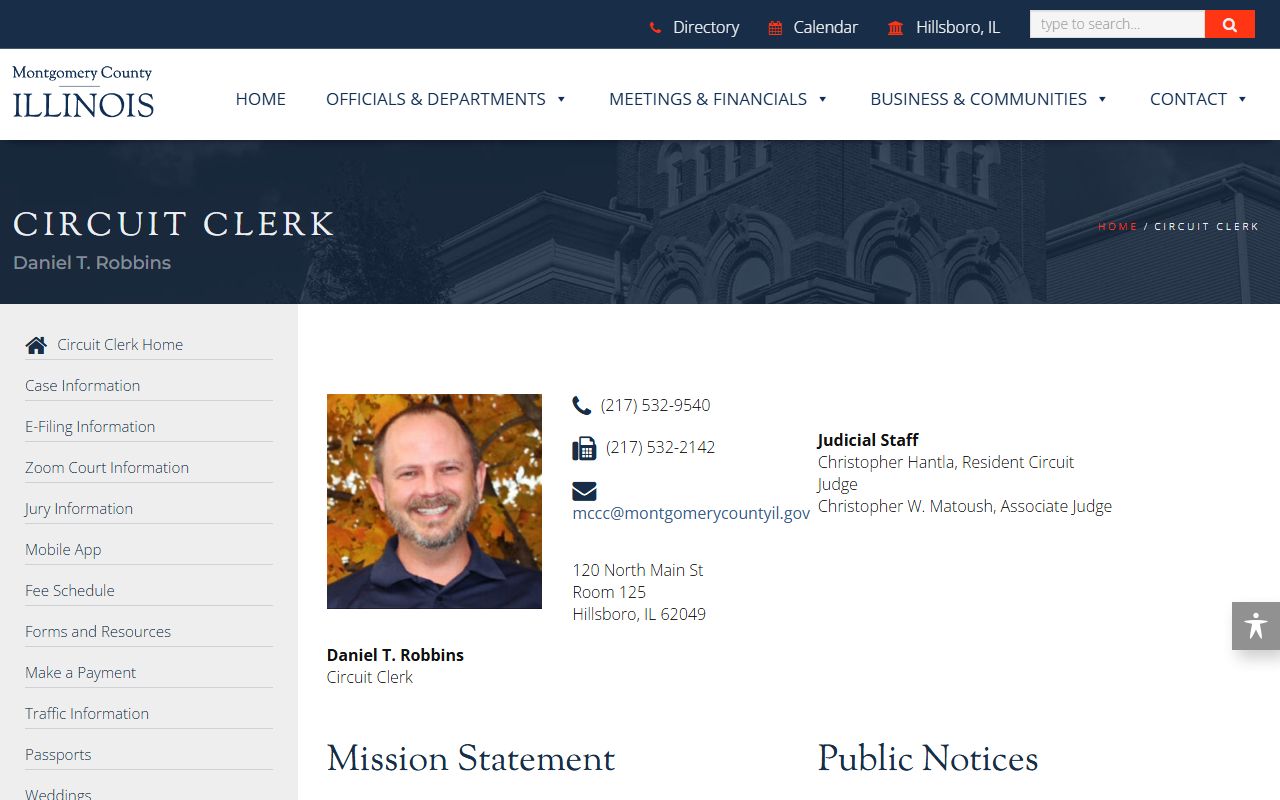
That page also notes copy fees are charged per page and that juvenile, adoption, and sealed files are not open to public inspection.
Statewide conviction history is a separate product. The Illinois State Police releases public conviction information under the Uniform Conviction Information Act, which is not the same as a pending Montgomery County case or a county booking record.
How Charges Get Filed After an Arrest: Complaint, Information, and Indictment
From the arrest forward, booking happens first, then the court record begins when the prosecutor files a charging document. The Montgomery County State's Attorney, Andrew Affrunti, prosecutes criminal actions in the name of the People of Illinois. The office may begin a case by complaint or information in misdemeanor or felony matters, or it may take a serious felony to the grand jury for an indictment. The three documents start a case in different ways, shown below.
| Complaint | Information | Indictment | |
|---|---|---|---|
| Filed By | Officer or prosecutor | Prosecutor | Grand jury |
| Common For | Misdemeanors | Many felonies | Serious felonies |
| Starts | The case | The case | The case |
The lead-in image below comes from the official Montgomery County State's Attorney page, which names the office and explains how charges begin.
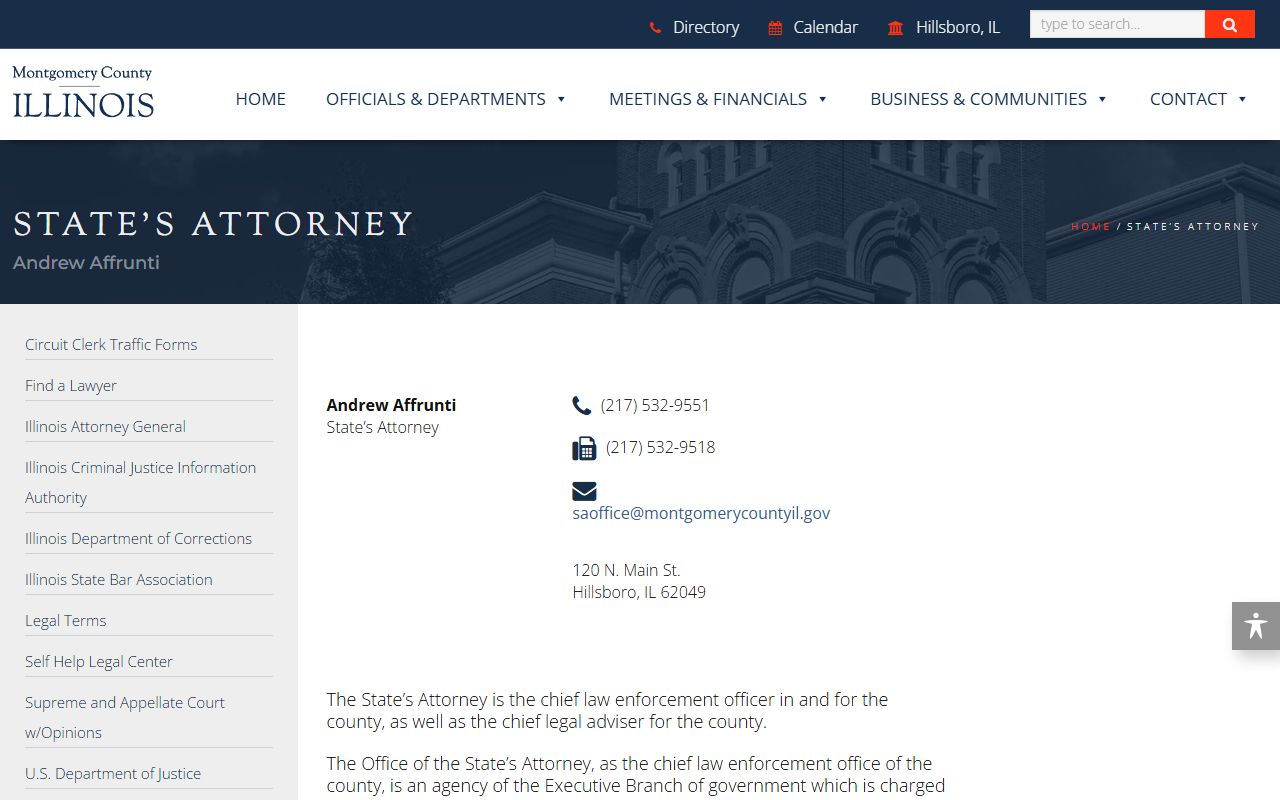
The State's Attorney is the office that decides the charge, which is why the court record can differ from the original booking charge. The office prosecutes misdemeanors and felonies, handles Illinois Vehicle Code matters including DUI cases, advises local police, counsels the grand jury, and commences extradition when a person charged here is held in another state. That broad role is the reason a charging decision is a State's Attorney question, while the case file itself sits with the Circuit Clerk.
Charge Status in Court Records After an Arrest
Charges shift as a case moves. A booking charge can reflect what the arresting agency wrote at intake, while the filed charge is what the prosecutor and court carry forward. Along the way, a charge may be amended, reduced, added, or dropped. The docket uses a handful of status terms, and reading them correctly avoids a wrong conclusion about where a case stands.
| Status | What It Means |
|---|---|
| Pending | The charge or case is unresolved and still moving through court. |
| Amended / Reduced | The charge text, class, or count changed, or it dropped to a lower offense. |
| Dismissed | The charge ended without a conviction on that count. |
| Nolle Prosequi | The prosecutor declined to go forward on the charge. |
Note: A warrant marked recalled or quashed is no longer active, but the docket wording can be technical, so confirm the status with the Circuit Clerk.
Release and Detention After an Arrest
Illinois changed how release works statewide. As of September 18, 2023, the state no longer uses the old cash bail system. Illinois Legal Aid describes the new framework as pretrial release. For a Montgomery County arrest, the court weighs release conditions or detention rather than a set cash amount, and the prosecutor may ask for detention in eligible cases. Older records and everyday speech still use the word bond, but a cash payment no longer guarantees release.
| Release Path | How It Works |
|---|---|
| Pretrial release with conditions | The court orders release under terms set without money bail. |
| Pretrial detention | The court orders custody in an eligible case after a hearing. |
| Warrant or hold | A separate legal reason that keeps a person in custody. |
| Sentenced custody | No release path; the person is serving a sentence or transferred to prison. |
To check a person's release status, call jail information at (217) 532-9514, then read the court file through Judici or the Circuit Clerk. Clerks can point to records but cannot give legal advice.
Warrants That Lead to an Arrest
Many arrests start with a warrant. The sheriff serves warrants requested by the State's Attorney and writs issued by the Circuit Court. No public online warrant search was located for the county, so a warrant is usually confirmed through the court file or by contacting the sheriff. A bench warrant, often issued after a missed court date, is one of the most common types tied to a later booking. The State's Attorney also handles extradition when a person is charged here and held in another state.
When a person is arrested on a Montgomery County warrant, the jail may book them and the court file should show the warrant and appearance events over time. If the arrest happened in another jurisdiction, the local jail line may not have the person until transfer. For records that are not given by phone, a FOIA request to the county FOIA Officer is the written route.
Charges vs. Convictions
An arrest and a charge are not a conviction. A charge is an accusation that opens a case. A conviction is the result of a plea or a verdict. Both can appear in public records, but they mean very different things, and a booking photo or arrest entry proves neither guilt nor a final outcome.
| Charge | Conviction | |
|---|---|---|
| Stage | Accusation | Verdict or plea |
| Burden of Proof | Probable cause | Beyond reasonable doubt |
| Public Record | Yes | Yes |
Sealed vs. Expunged Court Records After an Arrest
Illinois lets some records be sealed or expunged after an eligible outcome, such as a dismissal. Sealing hides a record from most public view, while expungement removes it more completely. Eligibility depends on the charge and the disposition, and the Circuit Clerk notes that juvenile, adoption, and sealed files are already closed to public inspection. The table compares the two.
| Sealed | Expunged | |
|---|---|---|
| Visibility | Hidden from public | Destroyed or treated as never existed |
| Law Enforcement | Limited access | Very limited |
| Eligibility | Depends on charge and disposition under Illinois law | Narrower; often dismissals or eligible outcomes |
Background Check Considerations
A casual court-record lookup is not the same as a regulated background check. Conviction history from the Illinois State Police follows the Uniform Conviction Information Act, which releases only conviction information to the public. A pending case, a dismissed charge, or a booking record is a different kind of record with different rules. People who need a screening for employment or housing must use an FCRA-compliant service, not a casual public search.
Important: This is a private reference site and not an FCRA-regulated consumer reporting agency, so its content cannot be used for hiring, housing, credit, or insurance decisions.
Restricted Court Records After an Arrest in Montgomery County
Some records stay out of public view even after an arrest. Juvenile cases, adoption files, and Circuit Court documents that a judge has sealed cannot be inspected by the public, per the county Circuit Clerk. Charges that are later sealed or expunged can also drop from a public search. A pending investigation may keep certain arrest details from release for a time. When a search comes up empty, one of these limits, rather than the absence of a case, is often the reason.
A few practical notes help when you visit the clerk in person. Inspection of open case files is free during the weekday hours, but copies carry a statutory per-page fee that the clerk did not publish as a fixed amount, so ask before you order. The Circuit Clerk also notes that personal checks drawn on banks outside Montgomery County are not accepted, which matters when you pay for copies. Staff can point you to a record, but they cannot give legal advice or interpret a charge for you.